



In the Beginning was Abiogenesis
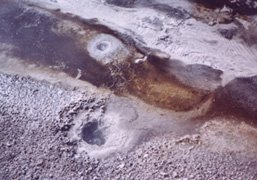 In current biological terminology "abiogenesis" refers to the emergence of life as self-replicating assemblages of chemicals from non-life assemblages of chemicals. This is the hypothesis that primordial life originated within the first 10 million years of Earth's history as a result of chemical reactions that generated larger and larger organic polymers, which ultimately attained the property of chemical self-replication.
This modern conceptualization is reasonable in view of what we now know of the demonstrable biochemical basis of all life. The modern conceptualization replaces earlier notions of "spontaneous generation" that viewed life as arising fully formed from non-living matter, or de novo. Such Aristotelian notions of archebiosis probably arose because much of life exists at the microscopic level of prokaryotes and unicellular eukaryotes, and some organisms living on detritus reach visible proportions after having been of microscopic size.
The term 'life' in relation to abiogenesis embraces the notion of utilization of energy sources to drive biochemical self-replication. This requires that an assembly of molecules and macromolecules acquired the ability to convert energy into growth and self-replication directed by informational macromolecules. A basic understanding of physical chemistry, biochemistry, biochemical energetics, and informational macromolecules is necessary to apprehend this concept.
Is the overall process depicted in the concept of abiogenesis one of pure chance? Of course not, rather the processes would have been governed by the non-random physical laws of chemistry, specifically those physical properties related to organic molecules. Since the processes involved would be widespread across the primordial planet, an enormous numbers of molecules and macromolecules would have been generated in the first 10 million years of Earth history. According to most theorists, conditions on Earth are no longer suitable for abiogenesis to occur. Abiogenesis requires a reducing environment, and oxygenic photosynthesis in Cyanobacteria converted the atmosphere to an oxidizing environment.
The exact elucidation/replication of abiogenetic mechanisms would be of enormous interest, yet this has never been a particularly active area of research because it has limited applications. The advent of space exploration has infused life into Astrobiology and the search for the Origin of Life. However, recent work, published in Nature, has demonstrated formation of activated pyrimidine nucleotides in a system consistent with early-Earth geochemical models.
Creationists, deliberately or out of ignorance, confuse the term abiogenesis with the term "evolution", which refers (in this context) to changes in the biology of living organisms over time. Creationists deceptively or mistakenly claim that evolution is not a fact. Biological evolution is a fact. That is, the fossil record and genomes demonstrate accumulated biological change over time. Denial or ignorance of a fact does not eliminate that fact.
Evolutionary theory deals with postulated mechanisms that explain the observed biological changes over time. Scientists do not claim that research on mechanisms of abiogenesis or biological evolution provide all the answers that they seek. This is not the problem that creationist love to claim it is, rather it one of the valuable features of scientific thinking. Proof exists only within mathematics, while most scientific reasearch employs empiricism and experimentation in order to disprove inaccurate theories – and thus to eliminate all but the best hypothesis. Basically, scientists seek the best possible explanation for an observed phenomenon, then move on to the next unanswered question. It is expected of scientists that they will abandon outmoded hypotheses.
Some creationists claim that evolution of biological forms cannot be explained without first accounting for the origin of life. This, like other creationist claims, is not a valid argument. The processes of abiogenesis and evolution affect two distinct areas of life. An analogy would be the construction of an automobile in a factory (origin) followed, independently of construction, by mechanical wear and tear (evolution). So, the mechanisms of biological evolution can be studied separately from the origin of life. Scientists may study the evolution of biological forms without any reference to the origin of life as assemblages of self-replicating chemicals.
From NASA's Astrobiology Institute
Spitzer Telecope Data Suggest that Life's Building Blocks are Abundant
Finding Life in Mars Analog Sites on Earth
More on Astrobiology:
Evolution and Ecology Beyond the Planet of Origin
Evolution and Development Workshop
New York Center for Studies on the Origins of Life
Ad Astra Magazine: Astrobiology Issue (January/February 1999)
The Astrobiology Web
Free audio on WAMC's Origins of Life Segments
Origins on Abiogenesis
Recommended on the Talk Origins Archive:
Lies, Damned Lies, Statistics, and Probability of Abiogenesis Calculations
Borel's Law and the Origin of Many Creationist Probability Assertions
Spontaneous Generation and the Origin of Life
Labels: abiogenesis, biopoiesis
| 3 Guide-Glossary
